
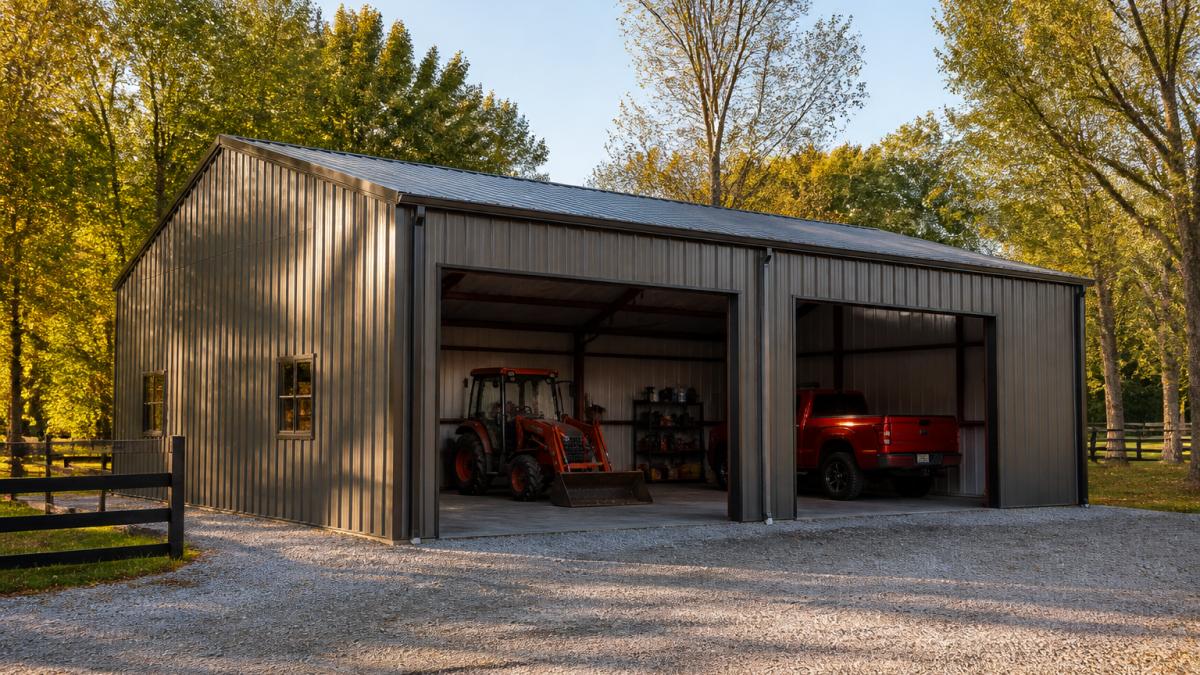

Why Steel Buildings Are Better for Rural Properties
Last Updated: October 22, 2026
Quick Summary
Steel buildings are better for rural properties because they resist rot, pests, fire, and severe weather while requiring almost no upkeep over a long service life. Rural structures take more punishment than most owners expect, so material choice matters more on a farm than on a suburban lot.
- Steel does not rot, feed termites, or add fuel to a fire the way lumber does.
- Ask for wind and snow load ratings in writing before you sign.
- Inspect the structure once or twice a year and touch up scratched finish.
- Terrapin Steel Buildings backs its 12-gauge steel framing with a 20-year manufacturer’s warranty.
- Confirm delivery truck access, gate widths, and drainage before ordering.
Table of Contents
- Why Steel Buildings Are Better for Rural Properties
- Steel Buildings vs Wood Buildings: A Rural Comparison
- Built for Weather, Pests, and Fire
- Steel Buildings for Farms: Storage and Asset Protection
- Steel Buildings for Equipment Storage
- Steel Building Maintenance: What It Actually Takes
- Total Cost of Ownership: Steel vs Conventional Construction
- Rural Site Prep, Permitting, and Climate Control
- Frequently Asked Questions
Why Steel Buildings Are Better for Rural Properties
Steel buildings are better for rural properties because they resist rot, pests, fire, and severe weather while requiring almost no upkeep over a long service life. This guide from Terrapin Steel Buildings breaks down where steel wins, where wood still makes sense, and what rural buyers should weigh before committing. Rural structures take more punishment than most owners expect. Distance from town means repairs are slow and expensive, and a failed roof or a termite-infested wall can sit unnoticed for months.
Below, we walk through durability, fire and pest resistance, farm storage use cases, maintenance realities, and the full cost picture so you can decide with clear eyes.
Steel Buildings vs Wood Buildings: A Rural Comparison
The short answer: steel outperforms wood on durability, pest resistance, and fire safety, while wood still wins on upfront price in some markets and on the look some buyers want. A steel building vs wood building decision usually comes down to how long you plan to keep the structure and how much maintenance you are willing to do.
Durability, Pests, and Fire: Where Steel Wins
Steel does not rot, does not feed termites, and does not burn the way lumber does. Those three facts alone change the ownership math for a rural shop or barn. Wood framing is vulnerable to moisture damage, mold, and insect activity over decades. A galvanized steel structure holds its shape and finish far longer with basic care.
Where Wood Still Makes Sense
Wood is not the wrong choice everywhere. If you need a small, inexpensive shed you may replace in ten years, lumber can be cheaper upfront. Some buyers also want a traditional barn aesthetic that steel panels do not replicate. Be honest about your timeline before you decide.
Built for Weather, Pests, and Fire
Steel structures handle extreme climates, high winds, and heavy snow loads when they are engineered for the site. That last clause matters. A steel building rated for your region’s wind and snow conditions performs very differently from a generic kit. Ask any supplier for the engineering documentation behind the structure.
Pest resistance is where steel pulls ahead of almost any alternative. Termites, carpenter ants, and rodents do not eat steel. Rot and mold need organic material to grow, and steel framing gives them nothing to feed on. Fire resistance is another advantage: steel framing does not add fuel to a fire the way wood framing does, which can slow a structure fire and protect equipment stored inside.
Ask for the wind and snow load ratings in writing before you sign. A structure engineered for a mild climate can fail in a region with heavier snow or stronger gusts, and the certificate is what your inspector will want to see.
Steel Buildings for Farms: Storage and Asset Protection
Steel buildings for farms solve one problem above all others: protecting expensive assets from the elements. Tractors, implements, feed, and livestock all last longer under a roof that does not leak, warp, or rot.
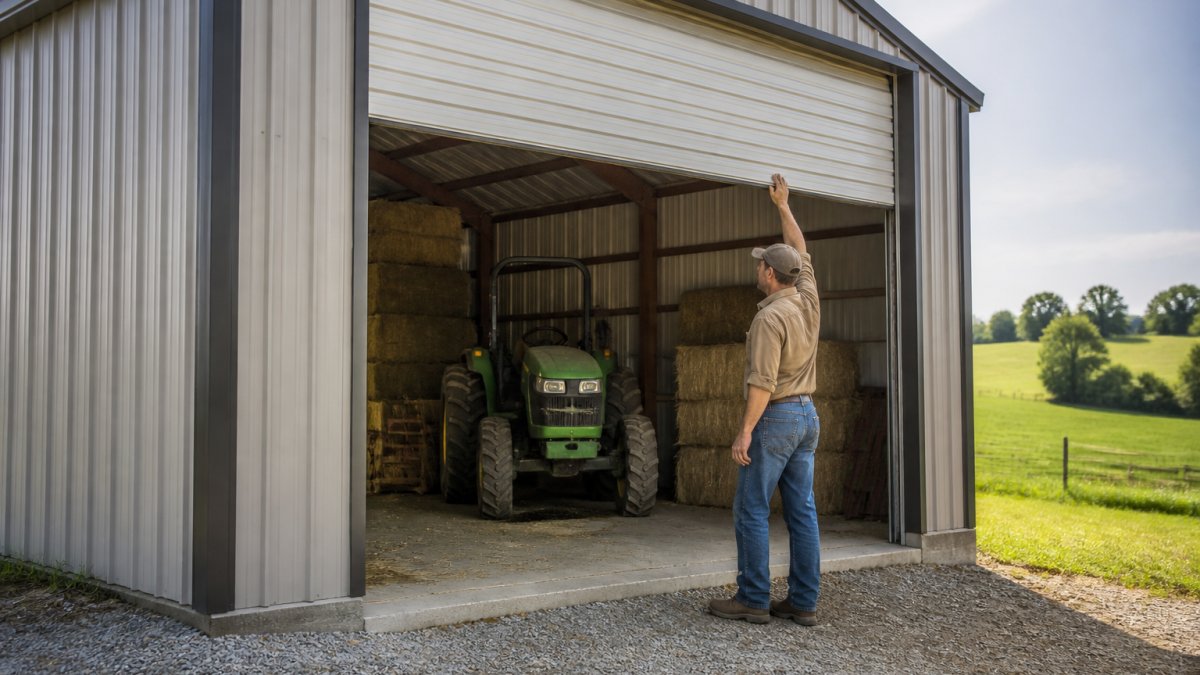
The more useful question is not whether steel protects assets, but which configuration fits your operation. The table below compares the four most common rural use cases and the trade-offs that actually affect daily use.
| Use Case | Priority Features | Trade-Offs to Plan For |
|---|---|---|
| Equipment and implement storage | Wide roll-up or sliding doors, clear span, reinforced floor slab | Door height limits future equipment; condensation drips on cold metal without insulation |
| Hay and feed storage | Ventilation, elevated pad, moisture control | Poor airflow causes mold; open sides invite rain blow-in and birds |
| Livestock housing | Ridge vents, sidewall openings, insulation, moisture management | Uninsulated steel swings in temperature; ammonia and condensation need active ventilation |
| Workshop and repair bay | Insulation, electrical rough-in, lighting, clear span | Thermal bridging at framing; noise amplification; floor slab thickness for lifts |
Equipment, Crops, and Livestock Under One Roof
A single well-planned agricultural building can serve several jobs, but mixing uses requires planning up front. Many farm owners use one structure for equipment on one side and feed or hay storage on the other, separated by an interior partition.
Livestock housing needs ventilation and moisture control, so plan the layout before you order. Steel does not absorb moisture, but an unventilated steel barn will collect condensation on the underside of the roof and drip onto bedding, feed, and animals. Ridge vents, eave vents, and open sidewalls move humid air out; mechanical ventilation may be needed in tight, insulated buildings.
Measure your tallest and widest piece of equipment, add clearance for mirrors or folded implements, and specify door and eave height from that number. Resizing a door after delivery is far more expensive than ordering it correctly the first time.
Matching the Building to the Operation
A hay barn and a repair shop have opposite priorities. Hay needs airflow and a dry floor; a shop needs insulation, power, and a flat, thick slab. If you plan to convert space later, tell the supplier at design time so the frame, slab, and wiring rough-in can accommodate it. A steel structure is flexible, but the cheapest flexibility is the kind you plan before fabrication, not after.
Steel Buildings for Equipment Storage
Equipment storage is the use case that pays for itself fastest. Sun and rain shorten the life and resale value of tractors, trailers, and implements. A covered, dry space slows that wear and gives you a place to do maintenance out of the heat. One of our customers put it plainly after buying a large shop: their tractors and equipment no longer sit out in the rain and sun, and they finally have a place to work on them out of the weather.
The cheapest equipment storage is the one you never have to replace. A durable steel structure protects the machines that earn your income, and that protection compounds over the life of the building.
Steel Building Maintenance: What It Actually Takes
Steel building maintenance is minimal: inspect the structure once or twice a year, keep fasteners tight, clear debris from the roof and gutters, and touch up any scratched finish. That is the honest list. There is no repainting schedule, no rot repair, and no pest treatment.
A common mistake is ignoring small scratches and dings on the panels. Left alone, a damaged finish can invite corrosion over time, especially in wet climates. A quick touch-up now prevents a bigger repair later. Buyers who have dealt with rust on older steel structures should ask specifically about the coating and galvanized finish on any building they consider.
Total Cost of Ownership: Steel vs Conventional Construction
Total cost of ownership is where steel quietly pulls ahead. The upfront sticker price is only part of the story. Over a long service life, a steel structure avoids the recurring costs that come with conventional construction: repainting, rot repair, pest treatment, and eventual replacement of failing wood components.
| Cost Factor | Steel Building | Conventional Wood |
|---|---|---|
| Upfront material cost | Higher in some cases | Often lower |
| Repainting and refinishing | Not required | Periodic |
| Rot and pest repair | Not applicable | Ongoing risk |
| Fire insurance exposure | Generally lower risk | Generally higher risk |
| Expected service life | Long | Shorter without upkeep |
Pricing for any structure depends on size, customization, and site conditions, so we do not quote a single figure here. Request a quote for current numbers on your specific project. Financing and rent-to-own options can make a permanent improvement easier to budget for.
Rural Site Prep, Permitting, and Climate Control
Site preparation, permitting, and climate control are the three items rural buyers most often underestimate. Each one can change the cost and timeline of a project before a single panel is delivered, so they deserve attention before you sign a contract.
Site Preparation and Delivery Access
A steel building arrives on a truck, and rural access is not guaranteed. Before ordering, confirm that a delivery truck and, if needed, a crane or boom truck can reach the build site. That means checking gate widths, overhead lines, bridge weight limits, driveway surface, and turn radius.
Grading and drainage matter as much as access. The pad should be level, compacted, and sloped so water drains away from the structure, not toward it.
Utilities are part of site prep too. If you want power, water, or a septic connection in the building, trench and rough-in before the slab is poured. Retrofitting utilities through a finished slab is expensive and disruptive.
Permitting and Code Requirements
Permitting means your county’s building codes, and rural counties can be stricter than buyers expect. Ask whether the structure is engineer-certified to meet local or state codes before you buy. Common requirements include stamped engineering drawings, wind and snow load ratings for your area, and sometimes agricultural exemptions that apply only to certain uses. An exemption for a hay barn may not cover a workshop with electrical service.
Confirm zoning and setback rules as well. A building placed too close to a property line or road may need a variance, and the approval process can take weeks. Get the permit requirements in writing from your local building department before fabrication begins.
Do not assume an agricultural exemption covers every structure on the property. Uses, sizes, and utility connections can change which rules apply, and a building that fails inspection is expensive to fix after the fact.
Insulation, Condensation, and Climate Control
Climate control is the trade-off worth naming honestly. Steel conducts heat and cold, so an uninsulated steel building will be hotter in summer and colder in winter than you might like. Insulation and condensation control add cost, but they make the building usable year-round. If you plan to work inside or house livestock, budget for insulation from the start.
Condensation is the mechanism most owners miss. Warm, moist air inside a building meets a cold steel roof or wall and condenses into water. That water drips onto stored equipment, hay, and animals, causing the exact moisture damage the building was meant to prevent.
Site prep, permitting, and climate control are cheaper to plan than to fix. Confirm access, drainage, code requirements, and insulation strategy before fabrication, not after delivery.
Frequently Asked Questions
Are steel buildings better than wood buildings for farms?
For most farm storage, steel wins on durability and upkeep. Steel does not rot, feed termites, or need repainting, and it holds up to high winds and heavy snow better than wood framing. Wood still makes sense for small sheds or where local codes and budget favor it. Weigh your climate, intended use, and long-term repair costs before deciding.
How long do steel buildings last?
A galvanized steel structure with proper installation and basic maintenance often lasts decades, and many buyers plan on 40 to 50 years of service. Longevity depends on the gauge of the framing, the quality of the finish, and how well the site drains. A 20-year manufacturer’s warranty on 12-gauge framing is a useful benchmark when comparing quotes.
Do steel buildings require a lot of maintenance?
Steel building maintenance is mostly inspection, not repair. Check fasteners, seals, and roof panels once or twice a year, clear debris from gutters and the base, and touch up any scratches in the finish. Unlike wood, you will not repaint or treat for pests. Keeping the site graded so water drains away is the single biggest thing you can do to protect the structure.
What are the disadvantages of steel buildings?
Steel is a poor insulator on its own, so added insulation is often needed for climate control and to prevent condensation, and that adds cost. Large clear-span designs can need engineered foundations. Some rural sites also need access improvements before delivery and installation. None of these are dealbreakers, but they should be in your budget and timeline from the start.