
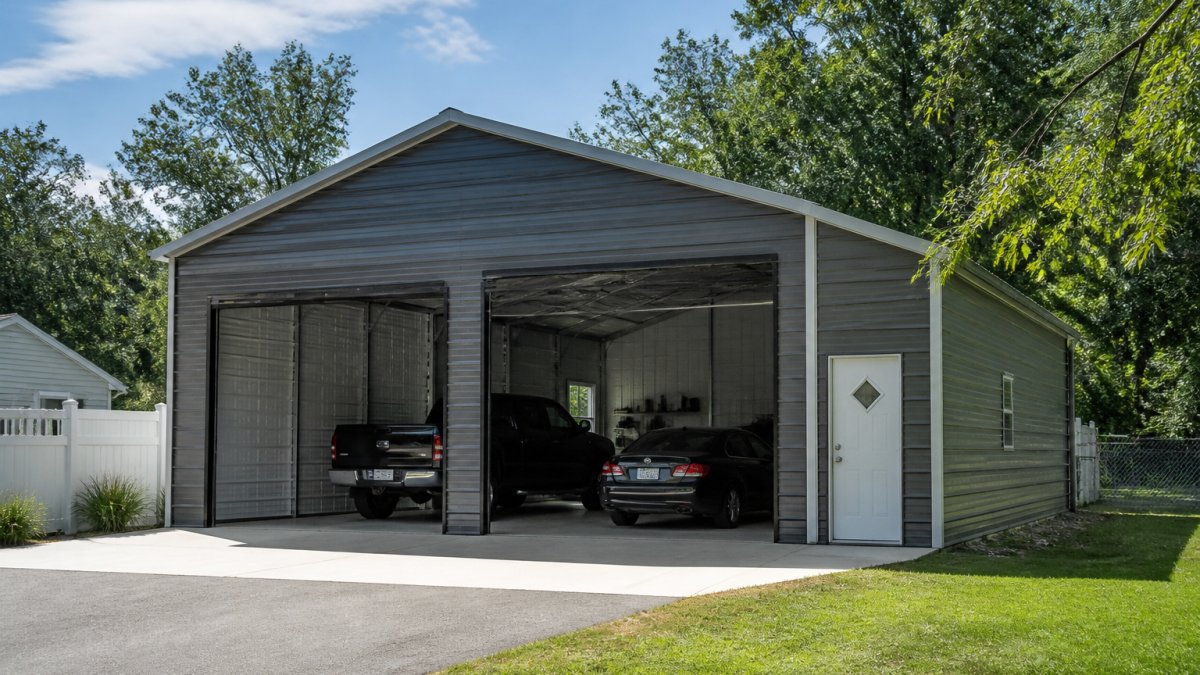

Is a Steel Garage Worth It for Property Value?
Table of Contents
- Is a Steel Garage Worth It for Property Value? The Short Answer
- Does a Metal Garage Increase Home Value?
- Steel Garage vs Traditional Garage: A Like-for-Like Comparison
- Metal Garage Cost: What Drives the Price and What You Get Back
- Steel Garage ROI: Calculating Your Real Return
- When a Steel Garage Adds the Most Value (and When It Doesn’t)
- Conclusion: Weighing the Investment Against Your Property Goals
- Frequently Asked Questions
Last Updated: October 14, 2026
Is a Steel Garage Worth It for Property Value? The Short Answer
Yes, in most cases, is a steel garage worth it for property value? A well-built detached garage adds covered space buyers look for and that shows up in appraisals, but the return depends on how it is built, permitted, and matched to your property.
At Terrapin Steel Buildings, we answer this weekly: the structure pays you back twice, it protects what you own and makes your property easier to sell.
Below: how appraisers value a steel garage, how it compares to wood-frame, and how to figure your return.
Does a Metal Garage Increase Home Value?
A metal garage can increase home value, but not automatically. Appraisers and buyers reward a garage that is permanent, permitted, and in good condition; a cheap carport or unpermitted shed rarely moves the needle. What drives the value bump:
- Covered parking that protects vehicles from sun, hail, and snow
- Extra storage for tools, equipment, and seasonal items
- A usable workspace for repairs, hobbies, or a small shop
Buyers in rural and suburban areas often rank storage and parking near the top of their must-have list, so a detached garage makes a listing stand out.
The value of a garage comes from the space it creates, not the material alone. A permitted, well-built steel garage almost always appraises higher than a temporary shelter.
What Appraisers Actually Look For in a Detached Garage
Appraisers use the comparable sales approach, comparing your property to similar homes that recently sold. A detached garage helps when nearby comps also have garages.
Here is what an appraiser checks:
- Permanent vs. portable: A structure on a foundation counts. A movable carport usually does not.
- Permits and code compliance: Unpermitted work can be excluded from value.
- Condition and age: Rust, dents, or sagging framing lower the number.
Appraisers do not pay extra just because the building is steel. They pay for function, condition, and paperwork, which is why we push engineer-certified plans and clean installation on every project.
Steel Garage vs Traditional Garage: A Like-for-Like Comparison
Steel garages beat wood-frame on durability, pest resistance, and long-term upkeep; wood wins on matching certain home styles and on buyer and appraiser familiarity. Both can add value, the right pick depends on climate, budget, and how long you plan to stay.
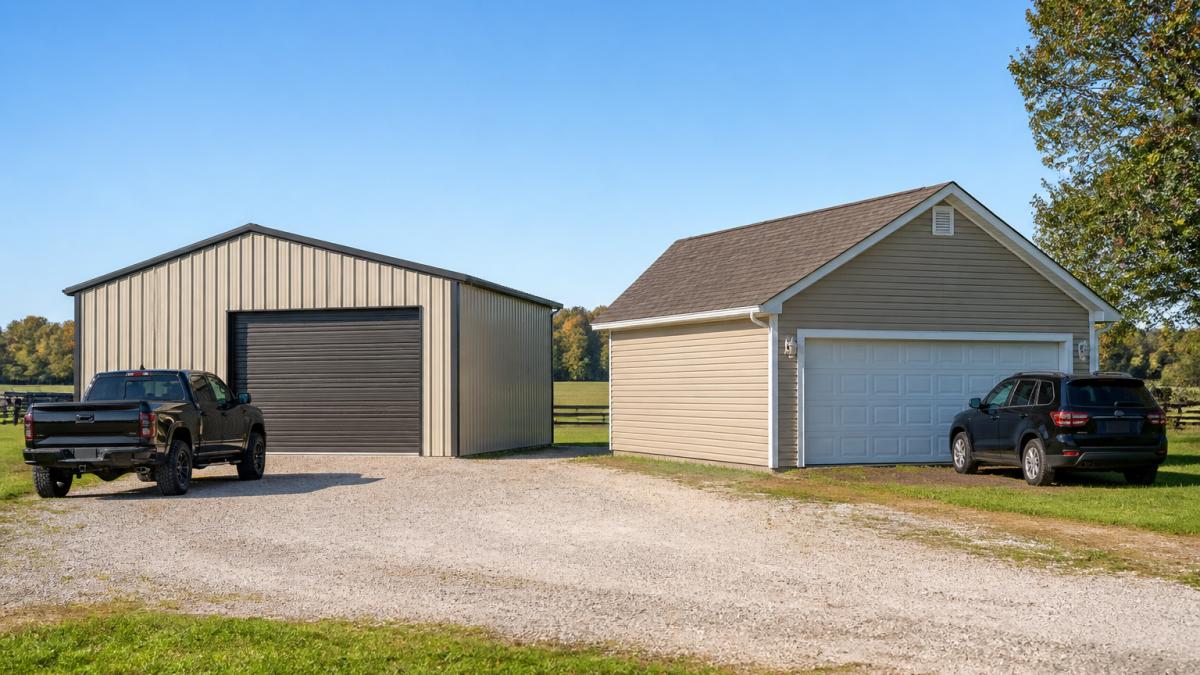
A like-for-like comparison has to line up the five things that move your bottom line: upfront cost, lifespan, maintenance, appearance and buyer acceptance, and resale impact.
| Factor | Steel Garage | Wood-Frame Garage |
|---|---|---|
| Upfront cost | Often lower for the shell; foundation and doors drive the total | Often higher per square foot once framing, sheathing, siding, and roofing are added |
| Lifespan | Steel framing does not rot or feed termites; service life is usually limited by the foundation, fasteners, and finish | Service life depends heavily on moisture control, flashing, and repainting cycles |
| Maintenance | Little to no repainting; inspect fasteners, seals, and any cut edges | Repaint, caulk, and repair siding and trim on a recurring cycle |
| Weather and pests | Handles wind, snow, and hail well when anchored and braced correctly; termites and rodents ignore steel | Can warp, rot, or swell; termites and carpenter ants are real risks |
| Appearance | Clean, industrial look; color and trim options are wide but the profile reads as metal | Blends with traditional home styles; easier to match existing siding and rooflines |
| Buyer acceptance | Strong in rural, agricultural, and storm-prone markets; can read as “outbuilding” in some historic or tightly styled neighborhoods | Broadly familiar to buyers and appraisers in most markets |
| Resale impact | Depends on permits, condition, and whether nearby comps have similar structures | Same rule applies: comps and condition drive the number, not the material |
Where the Cost Difference Actually Shows Up
A steel shell is often cheaper per square foot than a wood-frame shell of the same size, but the gap narrows or flips once you add the full project. The deciding items are the same for both:
- Foundation or slab: Required for either, and often the single largest line item after the building itself.
- Site prep and grading: Clearing, leveling, and drainage can rival the building cost on a sloped or wet lot.
- Doors and openings: A wide roll-up door, a walk door, and windows add up quickly, and insulated doors cost more than uninsulated ones.
Steel usually wins on the shell and lifetime maintenance; wood stays competitive when the homeowner wants the garage to match the house exactly.
Durability, Maintenance, and Lifespan
Steel framing does not rot, warp, or feed termites, the core advantage, and why many rural property owners switch to steel.
A metal building with 12-gauge steel framing holds its shape through heavy snow and high wind when properly anchored and braced, while wood framing can swell with moisture and crack.
What most guides miss is the foundation: a steel garage is only as strong as the slab or footing under it, and poor site prep causes more problems than the framing ever will.
Ask for the steel gauge before you buy. Thicker framing, like 12-gauge, resists dents and wind far better than thin panels. It is the single spec that separates a building that lasts from one that does not.
Appearance and Resale: The Honest Trade-Off
Wood-frame garages have one real advantage steel cannot fully match: they blend with traditional home styles.
Steel’s resale advantage is different: in rural, agricultural, and storm-prone markets, buyers often value a steel structure more because it survives weather and pests with less upkeep.
The practical rule: match the material to the market. In a stylistically tight neighborhood of wood-frame garages, wood may hold value better; where nearby properties have steel shops, barns, or outbuildings, steel competes on equal footing.
Metal Garage Cost: What Drives the Price and What You Get Back
Metal garage cost depends on size, site prep, foundation, doors, and installation.
The main cost drivers:
- Building size and height (a larger span needs more steel)
- Site preparation and grading
- Foundation or slab work
Pricing depends on your specs, location, and current material costs, so we do not publish flat prices. Request a quote and we will walk you through the numbers line by line.
FEMA guidance on safe rooms and wind-resistant construction explains why anchoring and foundation quality matter so much in storm-prone areas. That is also where a cheap build fails first.
Permits, Zoning, and Insurance: The Hidden Value Factors
Permits, zoning, and insurance decide whether your garage counts as real value or a liability. Skip them and you can lose the value you paid for.
Before you build, check:
- Building permit: Most counties require one for a permanent structure.
- Zoning and setbacks: Rules control how close you can build to property lines.
- Insurance: Adding a structure can change your policy. Tell your insurer.
A permitted garage appraises and sells cleanly. An unpermitted one can stall a sale or force a teardown. Engineer-certified plans, like the ones we provide, help your structure pass inspection the first time.
Steel Garage ROI: Calculating Your Real Return
Steel garage ROI is the value it adds divided by what you spent, after all project costs.
The gap most guides leave open is the difference between gross value added, what the market pays for the extra covered space, and net return, what is left after subtracting every dollar the project consumed. Those two numbers can point in opposite directions.
Gross Value Added vs. Net Return
Start by separating the two.
Gross value added is the difference between what your property sells for with the garage and without it. Appraisers estimate it through the comparable sales approach, finding recent sales of similar homes with and without garages and adjusting for size, condition, and features.
Net return is gross value added minus the full project cost. The full project cost is almost always larger than the building quote. It includes:
- Building shell and any options
- Site preparation, clearing, and grading
- Foundation or slab
A garage that adds real value can still produce a thin or negative net return if site work, utilities, and driveway push the total past what the local market pays for covered space.
How Appraisers and Comparable Sales Treat a Detached Steel Garage
Appraisers do not pay extra because a building is steel. They pay for function, condition, and paperwork, anchored to what similar properties in your market have actually sold for. Your garage’s treatment depends on four things:
- Comparable sales. If nearby homes with detached garages have sold recently, the appraiser has a basis for an adjustment. If almost no home in your area has a detached garage, the appraiser may give it little or no contributory value, regardless of what it cost to build.
- Permitted status. A permitted structure on a permanent foundation is treated as part of the real property. An unpermitted structure may be excluded from the appraisal, flagged as a condition of the sale, or required to be removed or retroactively permitted before closing.
- Quality and condition. A two-car garage with power, a concrete floor, and a finished exterior scores higher than a dirt-floor shed with exposed framing. Rust, dents, and sagging doors lower the adjustment.
- Permanence. A structure on a slab or footing counts. A movable carport or a building on skids usually does not, because it is not considered a permanent improvement to the land.
Contributory value typically lands between a fraction of cost and full cost, depending on how well the garage matches the neighborhood. Where covered parking and storage are scarce, it can approach or exceed cost; where every home already has an attached garage, the marginal value of a second detached structure is smaller.
Gross value added is what the market pays for the space. Net return is what is left after site work, foundation, permits, utilities, and ongoing costs. Track both, and never quote a national percentage as if it were your number.
A Worked Way to Estimate Your Own Return
You do not need a national statistic to estimate your return. You need local data and a full cost list.
- Build the full cost list. Every line item above, not just the building quote. Add a contingency for site surprises, because grading and drainage issues are common.
- Pull recent comps. Ask a local real estate agent or appraiser for recent sales of homes with detached garages and similar homes without. Look at the price difference, adjusted for size and condition.
- Estimate gross value added. Use the comps to bracket a range, not a single number. If no comps have detached garages, expect a lower contribution.
- Subtract full cost from gross value added. That is your net return in dollars.
- Divide net return by full cost. That is your net ROI as a percentage.
- Add the non-appraisal value. Years of protected parking, storage, and workspace have real value even when an appraiser cannot measure them. For a farm or a small business, avoided equipment wear and faster daily work can matter more than the resale number.
What Changes the Answer Most
The variables that move net return most are:
- Local demand for covered space. In areas with harsh winters, hail, or heavy sun, buyers pay more for a garage. In mild markets with abundant attached garages, they pay less.
- Lot size and placement. A garage that fits the lot and the driveway adds value. One that crowds the house, blocks views, or sits in a flood-prone corner does not.
- Neighborhood norms. A workshop garage is a major draw on a rural property and a minor one in a dense suburb. Match the build to the market, not to a generic checklist.
IRS guidance on capital improvements and basis notes that permanent improvements can affect your property’s tax basis. Keep your receipts and permit records, because they support both your tax position and your resale documentation.
When a Steel Garage Adds the Most Value (and When It Doesn’t)
A steel garage adds the most value when it fits the neighborhood, is permitted, and matches what buyers want. It adds the least when it is oversized, unpermitted, or out of place.
It tends to pay off most when:
- Nearby homes already have garages
- You live in an area with harsh weather
- Buyers need storage, parking, or workspace
It tends to pay off least when:
- The garage is far larger than the neighborhood supports
- It sits on a poor foundation or in a bad spot
- Permits and code compliance are missing
Building without a permit is the most common and most expensive mistake. It can block your sale, void coverage, and force you to tear the structure down. Pull the permit first.
Conclusion: Weighing the Investment Against Your Property Goals
The honest answer to whether a steel garage is worth it for property value is: it depends on how you build it.
That is where we come in. Terrapin Steel Buildings delivers 100% American-made steel structures, engineer-certified to meet local and state codes.
Get started with Terrapin Steel Buildings and add lasting value to your land. Request a quote today.
Frequently Asked Questions
Does a steel garage increase home value?
Yes, a steel garage can increase home value by adding covered parking, storage, and usable workspace. Appraisers typically credit detached garages based on comparable sales in the area. The increase depends on local buyer demand, how well the structure matches the home, and whether it is permitted and in good condition. A well-built steel garage on a property that lacks covered parking often sees a stronger value bump than one added to a home that already has a garage.
How much value does a detached garage add to a property?
The value added varies widely by region and property type. In rural and suburban markets where storage and vehicle protection matter, a detached garage can contribute a meaningful percentage of its construction cost to appraised value. However, appraisers rely on comparable sales, so the increase is capped by what similar properties with garages actually sell for. A steel garage that is permitted, matches the property’s use, and is in good condition tends to appraise closer to its full contribution.
Is a steel garage cheaper to build than a wood garage?
Steel garages often cost less upfront than wood-frame construction because prefabricated steel components arrive ready to assemble, reducing labor time. Steel also avoids costs tied to rot, termite treatment, and painting. However, site preparation, foundation work, and permits apply to both. The total metal garage cost depends on size, customization, and local labor rates. For a like-for-like comparison, steel typically delivers a lower long-term cost of ownership due to minimal maintenance.
Can a steel garage lower homeowners insurance costs?
In some cases, yes. Steel structures are fire-resistant and stand up well to high winds, hail, and snow loads when engineer-certified. Some insurers offer discounts for wind-rated or fire-resistant outbuildings, though this varies by carrier and policy. A steel garage also protects vehicles and equipment from weather damage, which can reduce claims over time. Ask your insurer whether a certified steel structure qualifies for a premium reduction on your specific policy.