
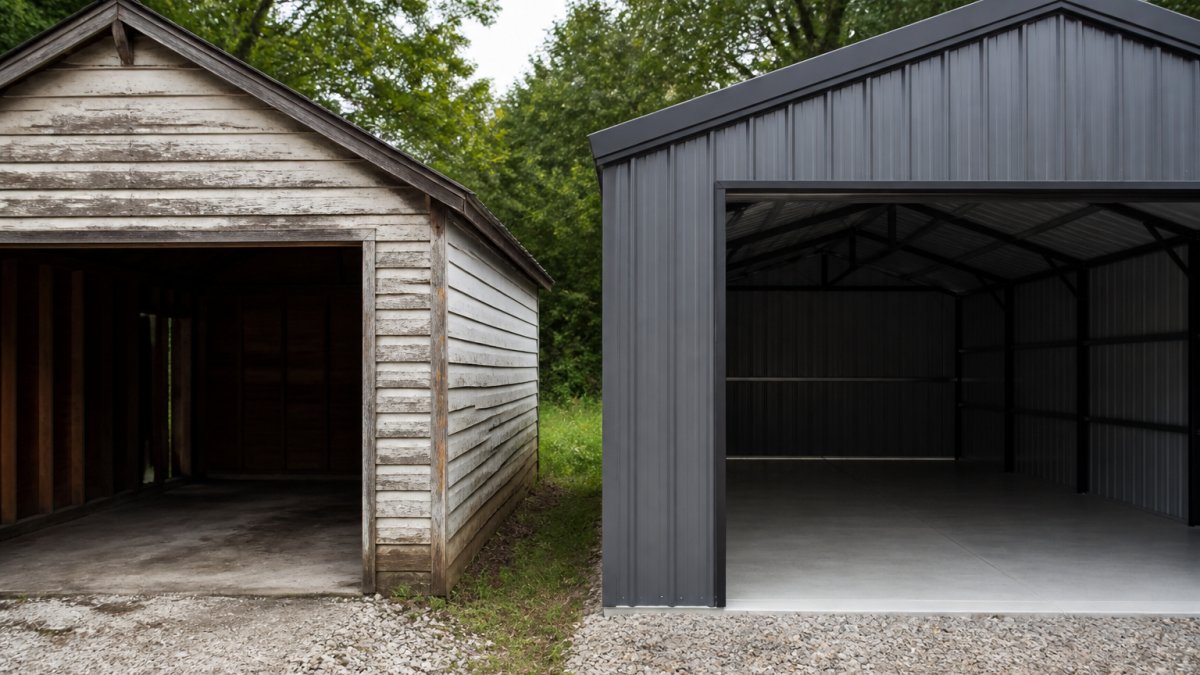

5 Benefits of Choosing Steel Over Wood Garages
Table of Contents
- Steel Garage vs Wood Garage: Why the Choice Matters
- Benefit 1: Steel Garages Resist Fire, Pests, and Rot
- Benefit 2: Steel Garages Are Built to Last in Severe Weather
- Benefit 3: Steel Garage Maintenance Is Minimal Compared to Wood
- Benefit 4: Steel Garage Cost and Long-Term Value
- Benefit 5: Prefab Steel Garage Pros and Cons
- Conclusion: Is a Steel Garage Right for You?
- Frequently Asked Questions
Last Updated: October 14, 2026
Steel Garage vs Wood Garage: Why the Choice Matters
Choosing between a steel garage and a wood garage shapes how much you’ll spend, how often you’ll repair it, and how long it protects your vehicles and equipment.
A steel garage is built from galvanized or coated steel framing and panels, engineered to carry wind, snow, and impact loads without the organic weaknesses of timber. No wood means no termites, no rot, and no repainting every few years.
The core difference isn’t price. It’s what the building does in years five through thirty, when wood needs attention and steel typically doesn’t.
Quick Comparison: Steel vs Wood Garages
| Factor | Steel Garage | Wood Garage |
|---|---|---|
| Fire resistance | Non-combustible | Combustible |
| Pest damage | Immune | Termites, rodents |
| Rot and warping | None | Common in wet climates |
| Maintenance | Minimal upkeep | Paint, seal, repair |
| Installation time | Days | Weeks |
| Design flexibility | Custom widths, clear-span | Limited by lumber spans |
Benefit 1: Steel Garages Resist Fire, Pests, and Rot
Three failure modes destroy wooden garages: fire, insects, and moisture. Steel sidesteps all three.
Fire Resistance
Steel won’t feed a fire. Wood framing burns and spreads flames, while steel stays inert at the temperatures a garage fire reaches, a difference that protects everything around a structure holding fuel cans, mowers, or farm equipment.
Pest and Termite Resistance
Termites don’t eat steel. Neither do carpenter ants, powderpost beetles, or rodents looking for a chewable entry point. Wooden construction invites all of them, and termite damage often stays hidden until the framing has lost strength.
Rot, Moisture, and Warping
Wood absorbs moisture, then swells, warps, and eventually rots. Steel doesn’t. In humid or rainy regions, a wood-framed building needs constant vigilance around the base plate and eaves, where water sits longest. Coated steel panels shrug off that same moisture.
Benefit 2: Steel Garages Are Built to Last in Severe Weather
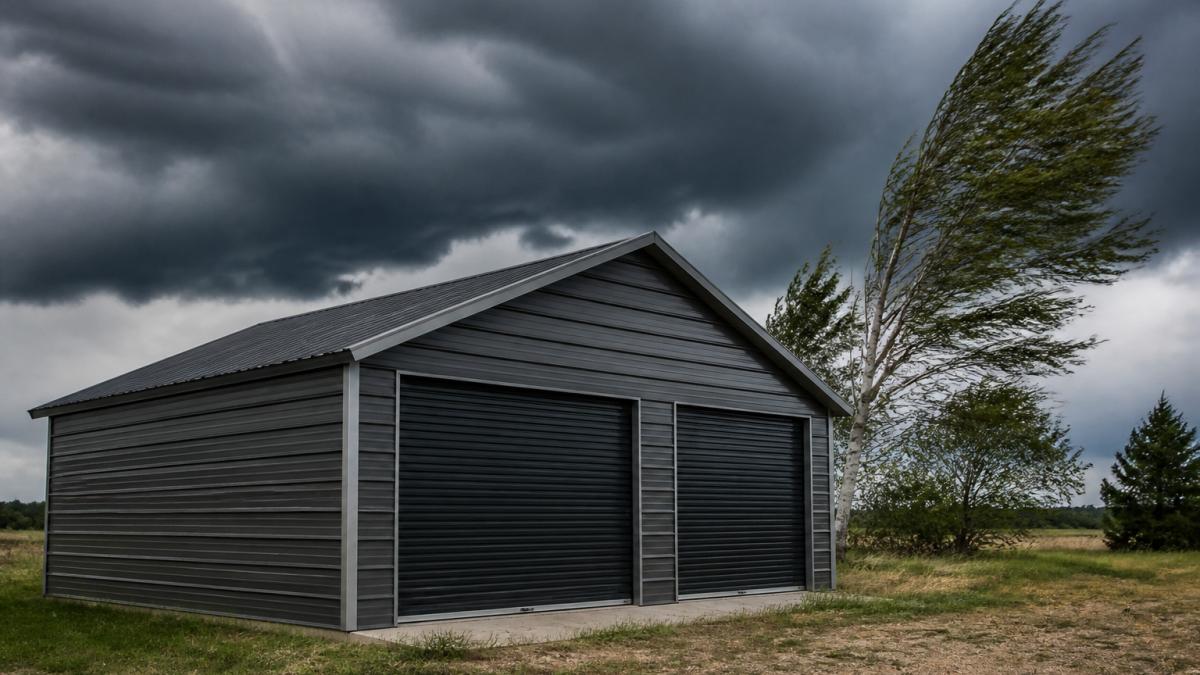
Engineered steel buildings are designed around the actual loads your region experiences, which is why they survive storms that damage stick-built structures. Wind resistance, snow load, and impact tolerance come down to engineering rather than luck.
Wood framing has natural weak points: knots, inconsistent grain, and joints that loosen as lumber dries and shrinks. A properly anchored steel building flexes under wind pressure instead of cracking, and its roof carries heavy snow without sagging.
If you’ve ever watched a wooden shed lean after a hard winter, you’ve seen the difference. Steel keeps its geometry.
Benefit 3: Steel Garage Maintenance Is Minimal Compared to Wood
Steel garage maintenance comes down to occasional inspection rather than recurring labor. Wood demands painting, caulking, sealing, and rot repair on a schedule that never ends. The gap isn’t just hours, it’s what happens when maintenance is skipped. Wood degrades quietly and then fails structurally; steel degrades visibly at the coating and can be corrected before the structure is affected.
Real Maintenance Schedules
Here is what a realistic calendar looks like for each material.
Steel:
- Annually: Walk the perimeter and inspect fasteners, panel seams, and the coating. Look for scratches, chalking, or any place where the finish has been breached.
- Annually: Confirm that soil, mulch, or gravel has not piled up against the base. Constant ground contact is the most common cause of premature coating failure.
- As needed: Touch up scratches with a matching repair coating. Small touch-ups prevent small problems from becoming panel replacements.
Wood:
- Every three to five years: Repaint or stain the exterior. This is the single largest recurring cost.
- Annually: Caulk joints, reseal the base plate, and check for soft spots in trim and siding.
- Annually: Inspect for termites, carpenter ants, and rodent entry points, and treat as needed.
That gap compounds. Every repaint is money and a weekend gone, and every missed cycle shortens the structure’s service life. Steel’s minimal upkeep is one of the clearest advantages of choosing steel over wood garages for anyone who would rather not spend retirement maintaining a shed.
How Common Damage Is Repaired
Repairability is where the two materials diverge sharply. A scratched or dented steel panel is usually repaired by cleaning the area and applying a matching touch-up coating; a badly damaged panel can be unbolted and replaced individually without disturbing the rest of the structure.
Wood is different. A rotted base plate or sill often requires removing siding and interior finishes to reach the damaged framing, and the repair frequently expands once the rot is visible.
Insulation, Condensation, and Energy Performance
A common misconception is that a steel garage cannot be insulated or will sweat in humid weather. Both concerns are manageable with the right detailing.
- Insulation. Steel buildings accept fiberglass batts, rigid foam board, or spray foam between the framing and the sheathing. Many owners insulate the roof and walls to create a conditioned workshop or to keep temperatures stable for stored equipment.
- Thermal bridging. Steel framing conducts heat more readily than wood, so an insulated steel building benefits from a thermal break, typically rigid foam or a continuous insulation layer, to reduce heat transfer through the framing.
- Condensation control. In humid climates, the priority is a continuous vapor barrier on the warm side of the insulation and adequate ventilation. Without those, warm moist air can condense on cool steel surfaces. With them, condensation is not a structural problem.
None of this is exotic, it’s standard building science, and the same decisions a wood building requires. The difference is that steel’s non-combustible, pest-resistant shell means insulation and vapor barrier aren’t competing with rot and insects for your attention.
Walk the perimeter once a year and check that no soil or mulch has piled up against the steel base. Keeping the bottom edge clear of constant ground contact is the single easiest way to extend the coating’s life.
In humid or coastal areas, do not skip the vapor barrier and ventilation plan. Condensation on an uninsulated, unventilated steel surface is a moisture-management problem, not a material failure, and it is preventable at the design stage.
Benefit 4: Steel Garage Cost and Long-Term Value
Steel garage cost is best judged over the whole life of the building, not just the day you buy it. The upfront number for wood can look lower, but long-term value usually swings to steel once you count maintenance, repairs, insurance, and replacement. Most cost comparisons stop at the sticker price; a lifecycle view runs the numbers across a defined period, typically 30 years, a reasonable service-life assumption for a coated steel structure, and adds up every dollar the building will demand.
Upfront Cost vs Lifecycle Cost
Wood often starts cheaper on materials. That advantage erodes quickly. Add repainting, pest treatment, rot repair, and the eventual rebuild, and the wood garage’s true cost climbs well past its sticker price. Steel front-loads more of the cost but spreads it across a much longer service life with far less upkeep.
| Cost Factor | Steel Garage | Wood Garage |
|---|---|---|
| Initial materials | Higher | Lower |
| Foundation and site prep | Engineered slab or pier plan; often similar | Conventional slab or pier; often similar |
| Installation labor | Factory-cut components; faster crew time | On-site framing; longer crew time |
| Recurring maintenance | Minimal, annual inspection and occasional touch-up | Frequent, repaint, reseal, pest treatment |
| Repair costs | Low; isolated panel or fastener replacement | Rising with age; rot and pest repair compound |
| Insurance premium | Often lower due to fire and wind ratings | Often higher due to combustible framing |
| Replacement timeline | Long | Shorter |
A few practical notes on each line:
- Foundation and site prep. Both materials need a level, drained pad. Steel buildings are frequently engineered for slab-on-grade or pier foundations, and the foundation scope is comparable to wood in most residential and agricultural applications. Steel’s lighter framing can reduce required footing depth in some engineered designs, a question for your builder, not a blanket rule.
- Installation labor. Prefabricated steel arrives cut, drilled, and labeled, so crew time is measured in days. Stick-built wood framing takes longer on site, and labor is usually the largest single line in a wood garage budget.
- Maintenance. Wood needs repainting every three to five years, plus caulking, sealing, and pest treatment. Steel needs an annual walk-around and touch-up of any scratched coating.
Climate Changes the Math
The lifecycle comparison isn’t the same everywhere. In humid or coastal climates, wood’s maintenance and repair costs climb faster because moisture and salt accelerate rot and corrosion. In dry climates with heavy snow, the deciding factor is often the engineered snow load rather than maintenance. In high-wind or hail regions, steel’s impact and wind performance can reduce repair frequency. Steel’s cost advantage widens in wet, humid, coastal, and storm-prone areas, and narrows in mild, dry climates where wood deteriorates slowly.
Apples-to-Apples Comparison Criteria
Before comparing two quotes, make sure they describe the same building. Steel gauge, framing design, coating system, and fastener quality vary widely, and so do lumber grade, sheathing, and workmanship.
Pricing for any specific structure depends on size, customization, and delivery, so we quote each project individually. Request a quote from Terrapin Steel Buildings for current numbers rather than relying on generic online estimates.
Compare quotes on the same scope, the same gauge or lumber grade, and the same load ratings. A lifecycle comparison only works when the two buildings are actually comparable.
Benefit 5: Prefab Steel Garage Pros and Cons
Prefab steel garage pros and cons come down to speed and precision versus a few real limitations. Prefabricated steel buildings arrive as engineered components, meaning faster installation, tighter tolerances, and predictable results.
The advantages:
- Construction speed measured in days, not weeks
- Engineer-certified designs that meet local or state codes
- 100% American-made steel with a 20-year manufacturer’s warranty on 12-gauge framing
- Factory-trained, licensed, and insured installation crews
The trade-offs:
- Custom sizes take planning time before delivery
- Site preparation still matters, so a level pad is required
- Some buyers expect a traditional wood look and prefer siding options
For most property owners, the pros outweigh the cons by a wide margin. A customer who bought a large shop for their farm put it simply: their tractors and equipment no longer sit out in the rain getting beaten by the sun, and the building gives them a place to work out of the heat.
Conclusion: Is a Steel Garage Right for You?
The hardest part of this decision is trusting that a higher upfront number pays off later, and that leap is where most buyers hesitate. Terrapin Steel Buildings makes it easier with 100% American-made structures, engineer certification to meet local and state codes, and factory-trained, licensed, and insured installation crews. Our 20-year manufacturer’s warranty on 12-gauge steel framing backs the durability claims with something concrete.
Frequently Asked Questions
Are steel garages better than wood?
Steel garages outperform wood in durability, fire resistance, pest resistance, and maintenance. Steel won’t rot, warp, or attract termites, and it holds up better in severe weather. Wood garages may cost less upfront and offer more traditional aesthetics, but steel’s long-term value and lower upkeep often make it the stronger choice for homeowners who want a structure that lasts decades with minimal attention.
Is it cheaper to build a garage out of wood or metal?
Wood garages typically have a lower upfront cost, but steel garage cost often proves more economical over time. Steel requires less maintenance, resists rot and pests, and can lower insurance premiums in some areas. When you factor in repair costs, repainting, and pest treatment for wood, steel’s lifecycle cost is frequently lower. Request a quote to compare pricing for your specific size and customization needs.
How long do steel garages last compared with wood garages?
A well-built steel garage can last 40 to 50 years or more with minimal maintenance, especially when the framing is protected with a quality coating. Wood garages often need significant repairs or replacement within 20 to 30 years due to rot, insect damage, and weather exposure. Steel’s lifespan advantage makes it a more reliable long-term investment for protecting vehicles, equipment, or inventory.
Do steel garages require less maintenance than wood garages?
Yes. Steel garage maintenance is minimal: occasional washing and touch-ups on scratches are usually all that’s needed. Wood garages demand regular painting or staining, caulking, and treatment for pests or rot, often every few years. Steel’s factory-applied protective coating resists corrosion and fading, so you spend less time and money keeping the structure in good condition over its service life.