


Steel Building Financing Options for Homeowners Explained
Last Updated: November 4, 2026
Quick Summary
Steel building financing for homeowners comes mainly from home equity loans, HELOCs, unsecured personal loans, and construction loans that convert to permanent mortgages. Unsecured options do not put your home at risk, while secured products usually carry lower rates. Price the full project scope, including foundation, site work, permits, and utilities, before choosing a lender.
- Unsecured personal loans skip pledging your home, but usually have smaller maximum amounts.
- Home equity loans pay a fixed lump sum, while HELOCs let you draw only what you need.
- Keep your debt-to-income ratio at or below roughly 43% of gross monthly income.
- Compare full APR, including origination fees and closing costs, not just the advertised rate.
- Many building-only loans exclude site work, utility connections, and landscaping, so confirm coverage.
Table of Contents
- How Steel Building Financing Works for Homeowners
- Types of Metal Building Loans and How They Differ
- Metal Building Construction Loans: Basics and Requirements
- Credit Score, Down Payment and Interest Rate Requirements
- Hidden Costs: Site Prep, Foundation, Permits and Insurance
- Rent to Own Steel Building Benefits Compared to Loans
- Requesting a Quote and Choosing Your Financing Path
- Frequently Asked Questions
How Steel Building Financing Works for Homeowners
Steel building financing for homeowners is more accessible than most people expect. Many lenders offer financing for metal and steel buildings, and some programs do not require home equity as collateral. That flexibility is why steel building financing options for homeowners deserve a closer look before you commit to a project.
Financing structures differ widely, and the right one depends on your credit profile, your land, and how quickly you need the building. This guide walks through the main options, what lenders typically require, and the costs that catch many buyers off guard.
Types of Metal Building Loans and How They Differ
Most homeowners choose between a few core loan types, each with a different trade-off between cost, speed, and risk.
Home Equity Loans vs. HELOCs
Home equity products use your house as collateral. A HELOC works like a revolving credit line, so you draw only what you need, which suits projects with uncertain costs. A home equity loan pays a lump sum at a fixed rate, which suits a project with a known price tag.
The main risk is obvious: the building is secured by your home. Missed payments can put the house itself at risk, so run the monthly payment against your budget before signing.
Unsecured Personal Loans
Unsecured personal loans skip the home as collateral entirely. Because nothing is pledged, approval rests mainly on credit history and income.
The trade-off is that unsecured loans usually carry shorter terms and smaller maximum amounts than secured products, so larger builds may not fit. Fixed-rate installment loans make monthly costs predictable, which is worth more than a slightly lower rate on a variable product.
Metal Building Construction Loans: Basics and Requirements
A construction loan funds the build itself, paying contractors in stages as work is completed. Many homeowners convert these into a permanent mortgage once the building is finished, a structure known as a construction-to-permanent loan. Lenders typically request engineering drawings, a contractor estimate, and proof that the building meets local permitting rules before releasing funds.
Expect a longer funding timeline than with a personal loan, since draws are tied to inspections. Requirements vary by lender, but the core items are consistent: a detailed project budget, a building permit or permit application, and a contractor you can document. Pre-qualification helps you learn your likely loan amount before you commit to a design.
Credit Score, Down Payment and Interest Rate Requirements
Credit score is usually the first gate, and it determines not just approval but price. Credit score is a major factor in both approval and rate. Each lender sets its own cutoffs, so ask lenders directly how your credit profile would be priced.
Lenders also examine your debt-to-income ratio, meaning how much of your monthly gross income already goes to debt payments (What is a debt-to-income ratio?). A common guideline is to keep total debt payments, including the new loan, at or below roughly 43% of gross monthly income, though some lenders allow more with compensating factors such as reserves or a long employment history.
Down payment and deposit
Keep two numbers separate in your budget: the loan down payment, which reduces the amount borrowed, and any supplier deposit, which is typically a separate payment and not part of the loan. Ask for your deposit terms when you request a quote from Terrapin Steel Buildings.
Interest rates and APR
Interest rates vary with the product, your credit, the loan term, and whether the rate is fixed or variable. Secured products such as home equity loans and HELOCs generally price below unsecured personal loans because the lender has collateral. Compare the full APR, including origination fees and closing costs, rather than the advertised rate alone, and ask whether the rate is fixed for the life of the loan or adjusts after an introductory period.
Documents and the application timeline
Lender document requirements vary, but applicants commonly provide identification, income and bank records, and a project description with the building quote. Ask each lender for its specific checklist.
Funding timelines depend on the lender and the documentation you provide. Construction loans add draw scheduling and inspections, so plan for a longer runway than a personal loan. Starting pre-qualification before you finalize a design keeps the financing from becoming the bottleneck.
Watch out: a pre-qualification is not an approval, and a hard credit pull at application can temporarily affect your score, so gather your documents and compare two or three lenders within a short window rather than applying one at a time over months.
Hidden Costs: Site Prep, Foundation, Permits and Insurance
The building kit is rarely the whole bill, and the gap between the kit price and the all-in project cost is where most financing plans break down. A loan sized only to the steel package can leave you short exactly when the concrete truck arrives. Price the full scope before you apply.
Site preparation and foundation
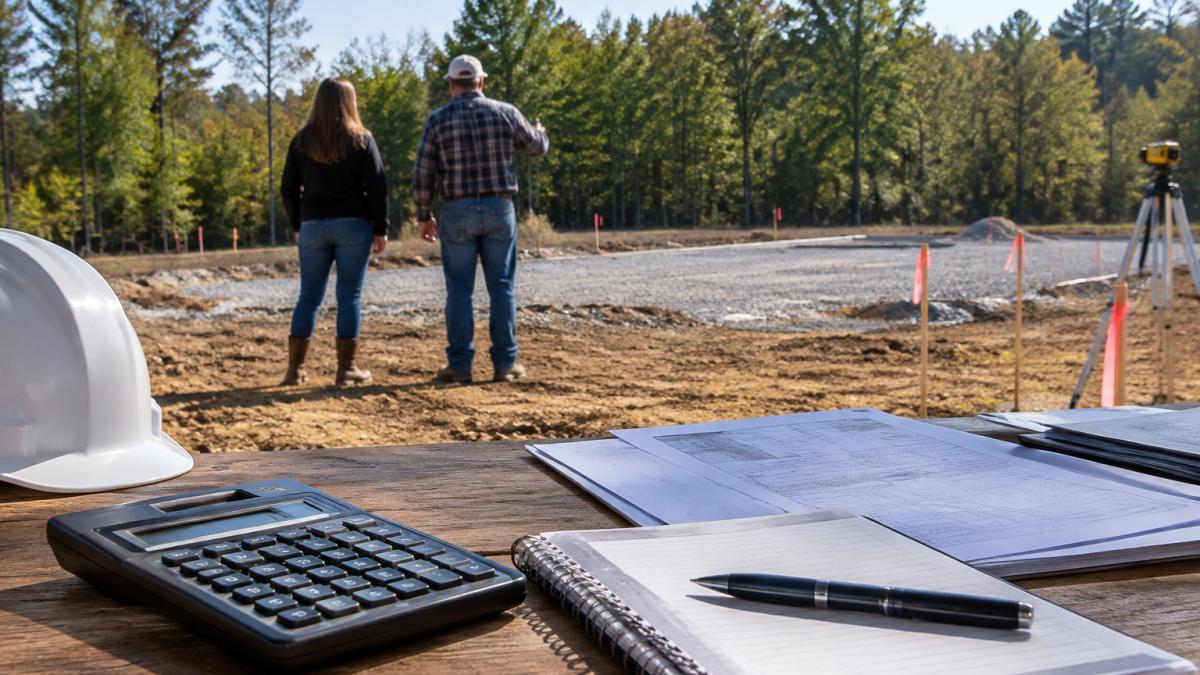
Site work typically includes clearing and grubbing, grading to a level pad, compaction, and erosion control. On sloped or poorly drained lots, cut-and-fill earthwork and retaining structures can rival the cost of the building itself. Foundation options range from a poured concrete slab to a gravel or crushed-stone pad, and the choice affects both cost and what the lender will finance. A slab foundation requires additional preparation before erection, while a gravel pad is simpler but may not satisfy every lender’s requirements. Learn how to prepare a concrete foundation for a steel garage.
Ask your lender exactly which of these costs the loan covers. Many construction and home improvement products fund the structure and permanent improvements but exclude movable site work, utility trenching, and landscaping. A common pattern is a loan sized to the kit plus slab, leaving the homeowner to fund grading, driveway, and electrical service out of pocket.
Permits, inspections, and utility connections
Building permits and inspection fees vary by jurisdiction and by structure size and use. Expect separate charges for the building permit, electrical and plumbing permits if the structure will be powered or plumbed, and inspection fees at foundation, framing, and final stages. Utility connections, including electrical service, water, and septic or sewer, are frequently the largest line item homeowners overlook, and they are often not covered by a building-only loan.
Insurance requirements for financed structures
This is where many guides go quiet, and it is where lenders get specific. A lender with a security interest in a steel building will typically require property insurance naming the lender as mortgagee or loss payee, with coverage at least equal to the loan balance or replacement cost. If the building is in a flood zone, the lender may require flood insurance. If it is used commercially or as a workshop with equipment, the lender may ask for commercial property coverage or a rider on your homeowners policy. Verify with your insurer before closing that the structure is insurable as built, because an uninsurable building can sink an approved loan.
Appraisal challenges for non-traditional structures
Appraisers value what they can compare. A steel building that is unusual for its market, partially finished, or used for a purpose the local market does not recognize can appraise below the contract price, and a low appraisal can reduce the loan amount or kill the deal. Lenders financing a steel structure often order an appraisal or a cost-based valuation, and they may require engineering drawings and a contractor’s estimate to support it. Knowing this in advance lets you choose a lender experienced with metal structures rather than one applying a standard residential template.
Watch out: a quote that lists only the kit and erection may not reflect the full project cost once foundation, site work, permits, and utilities are added, so build your loan request from a complete scope, not the kit price.
The building kit is rarely the whole bill, so here is a summary of the cost areas a loan may or may not cover. Get a detailed budget breakdown for your total project spend.
| Cost area | What it covers | Lender note |
|---|---|---|
| Site preparation | Clearing, grading, compaction, erosion control | Often excluded from building-only loans |
| Foundation | Poured slab or gravel/crushed-stone pad | Slab needs extra prep; gravel may not satisfy every lender |
| Permits and inspections | Building, electrical, plumbing, and inspection fees | Vary by jurisdiction and structure size |
| Utility connections | Electrical service, water, septic or sewer | Frequently overlooked; often not covered by a building loan |
| Property insurance | Coverage at least equal to loan balance or replacement cost | Lender typically named as mortgagee or loss payee |
| Flood insurance | Required if the building is in a flood zone | Lender may require it |
| Appraisal | Valuation of the structure | Low appraisal can reduce the loan amount |
Rent to Own Steel Building Benefits Compared to Loans
Rent-to-own offers an alternative to borrowing, letting you take possession of a building under a payment agreement with an ownership path at the end. Compare the full cost of any payment agreement against a conventional loan before deciding. See whether our rent-to-own option is worth the investment.
Rent-to-own suits buyers who cannot qualify for a loan now but expect to improve their credit. For buyers who qualify for competitive financing, a loan usually costs less overall.
Requesting a Quote and Choosing Your Financing Path
Start by pricing the building with a complete scope: size, foundation, site work, and permits.
Request a quote from Terrapin Steel Buildings to get a detailed scope that you can take to your lender. Plan a custom RV garage with workshop space before you reach out.
Frequently Asked Questions
What is the easiest steel building financing for homeowners?
Unsecured personal loans are often the simplest route because they do not require pledging your home. Approval depends mainly on credit and income, and amounts are typically smaller than secured options.
Can I finance a steel building without using home equity?
Yes. Some lenders offer unsecured personal loans and certain home improvement loans for metal buildings that do not require home equity or a property appraisal. Verify current lender partnerships before applying.
How much down payment do I need for a metal building?
It depends on the product. Some unsecured loans need no down payment, while steel suppliers commonly require a refundable deposit of 10% to 20% to lock in pricing.
Frequently Asked Questions
What is the best way to finance a metal building?
The best option depends on how much equity you have, your credit profile and whether you want a fixed or variable payment. Homeowners with substantial equity often compare home equity loans and HELOCs, which can borrow up to 85% of equity and carry lower rates than unsecured debt. Buyers without equity can look at unsecured personal loans. Get pre-qualified with two or three lenders and compare APR, fees and prepayment terms before committing to a contractor’s quote.
Do I need 20% down for a construction loan?
Down payment requirements for construction loans vary by lender, loan program and borrower credit. Many construction-to-permanent loans ask for a down payment or equity contribution, and some programs require a percentage of the total project budget. Unsecured personal loans for steel buildings often require no down payment at all, though approval depends on income and debt-to-income ratio. Ask lenders directly what they require for your specific project before assuming a set percentage.
Can I use a personal loan to finance a steel building?
Yes, many homeowners finance steel buildings with unsecured personal loans. Personal loans are unsecured, so they generally do not require home equity. Because they are unsecured, rates may be higher than secured options, so compare the total cost of interest over the full term.
How much should a 30×50 metal building cost?
Pricing depends on quantity, dates, delivery distance, building specifications, site conditions and local permit requirements, so we cannot quote a typical cost here. For current pricing on a 30×50 structure, request a quote from Terrapin Steel Buildings on our website. Budget separately for site preparation, foundation work, permits and insurance, which many quotes leave out.
